Inside the Kennedy 'Camelot': A Legacy Beyond Politics
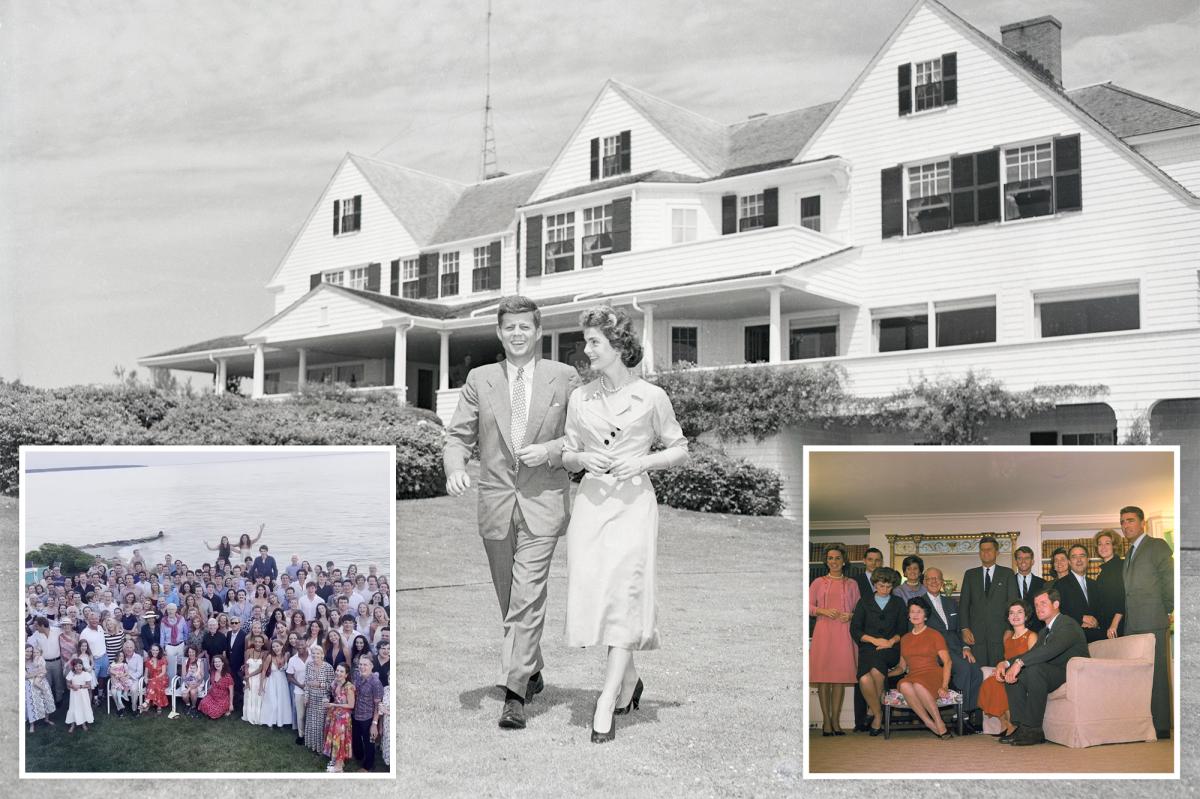
For nearly a century, the Kennedy family’s sprawling Hyannis Port compound has served as the backdrop to countless summer celebrations, where days were spent sailing on Nantucket Sound, swimming off the Cape Cod coastline and taking part in fiercely competitive games of touch football.The waterfront retreat became so synonymous with the political dynasty’s warm-weather traditions that images of the Kennedys gathered on its sprawling lawns or setting sail from its private pier helped cement the family’s idyllic “Camelot” image.And as summer drew to a close, the Kennedys could often still be found embracing the activities that had defined their months in Hyannis Port.John F. Kennedy and Jacqueline Bouvier stroll across the lawn of his family’s home after announcing their engagement. Bettmann ArchiveIt was there that John F. Kennedy spent his final Labor Day holiday in 1963, enjoying an activity-filled weekend with wife Jacqueline Kennedy, their children, relatives and friends just months before his assassination.Archival footage from that weekend captures the family swimming, boating and spending time along the waterfront—offering an intimate glimpse at the traditions that made the compound much more than a collection of impressive homes.A Kennedy playgroundLong before the Kennedy name became synonymous with American politics, summers in Hyannis Port were centered around family—and plenty of competition.JFK and Bouvier are interviewed for a LIFE Magazine story while on vacation at the Kennedy compound in June 1953 in Hyannis Port, Massachusetts. Getty ImagesThe Kennedy children grew up swimming, sailing, playing tennis, riding horses and facing off in games of touch football, activities that became deeply intertwined with the family’s time on Cape Cod.Kathleen “Kick” Kennedy, one of Joseph and Rose Kennedy’s nine children, was known to enjoy horseback riding, tennis, swimming, sailing and touch football during the family’s summers in Hyannis Port, according to the National Park Service.Those activities were hardly limited to one member of the family.Joseph Kennedy encouraged a competitive spirit among his children, and the expansive outdoor spaces and waterfront setting surrounding their summer home provided an ideal playground for the growing brood.Touch football, in particular, became one of the family’s most famous pastimes, with photographs of Kennedys tossing a football across the grass becoming nearly as synonymous with the compound as its shingled homes and ocean views.JFK and Bouvier play football with Edward Kennedy. Getty ImagesThe water was equally important. Sailing became a fixture of Kennedy family life, while swimming, boating and trips out onto NantucketDecades later, those same activities were still unfolding around the compound when JFK returned as president for Labor Day weekend in 1963.The compound takes shapeThe Kennedy compound in Hyannis Port holds almost as much lore as infamous political dynasty itself.This home was purchased in 1928 by family patriarch, diplomat, and businessman Joseph P. Kennedy for his wife, Rose, and their nine children, including JFK and Sen. Robert F. Kennedy. Over the years, the residence has become closely intertwined with the family’s storied history.It was at the Cape Cod retreat that JFK planned his presidential campaign in the summer of 1960, and it was there that his wife, Jackie, fled after he was assassinated in 1963 at the age of 46.Hyannis Port would be where Jackie crafted the image of Kennedy’s presidency as “Camelot” in the wake of his death, taking inspiration from the late politician’s favorite Broadway musical and telling the media in her first official interview after his passing: “Don’t let it be forgot, that for one brief, shining moment there was Camelot.”The home had been the site of many happy vacations for JFK and Jackie—and it went on to serve as a much-needed retreat for other family members over the years, becoming the site of an annual Fourth of July reunion for many of their descendants.The Kennedys might never have come to Hyannis Port if it hadn’t been for one pastime Joseph and Rose loved: golf. In 1926, and already a millionaire, Joseph went in search of a home near a golf club.He explored a membership at the Cohasset Country Club, on the South Shore and close to Boston. However, he was iced out, reportedly as a result of his Irish Catholic faith.Instead, the couple found Hyannisport Club on Cape Cod—then run by an Irish Catholic—and the Kennedys were welcomed. They proceeded to rent Malcolm Cottage, as it was then known and, in 1928, purchased the property for $25,000, according to the website for the JFK Museum in Hyannis.The 3-acre property on a dead-end street directly faces Nantucket Sound.While the Kennedy family spent time at other homes in New York, Maryland, and Florida, Hyannis Port is where they would create a multigenerational compound. Joe Kennedy expanded the main house, dubbed the Big House, to reportedly include 21 rooms, 12 bedrooms, a steam room, and a 50-person theater in the basement.The grounds offer a tennis court and pool, and other recreation options including golfing at the local club and sailing on the sound. Touch football, played on the grassy lawn, was also a favorite.JFK bought a home behind his father’s Big House in 1956. It became known as the President’s House. Robert F. Kennedy and his wife, Ethel, bought another adjacent home; and those three properties made up the compound, which now spans 6 acres of waterfront property.It was in the main house that JFK decided to run for president, and the home subsequently served as his campaign headquarters.The morning after the election, it was his young daughter, Caroline, who woke him up in their Hyannis Port home to announce, “Good morning, Mr. President.”During JFK’s presidency, the compound became the “seaside White House.” He once said of his Cape Cod home, “I always come back to the Cape and walk on the beach when I have a tough decision to make.”JFK and Bouvier sitting together in the grass at Hyannis Port. Bettmann ArchiveThe place became iconic when images emerged of Jack and Jackie spending time there with their children during the White House years.It’s also a place where family members have retreated to grieve tremendous loss over the years, from the deaths of Joe Kennedy Jr., the eldest son, in World War II, to JFK’s assassination in 1963 to RFK’s assassination in 1968, after he won the California presidential primary.Another tragedy, decades later, took JFK’s son, John F. Kennedy Jr., who died in a plane crash with wife Carolyn Bessette-Kennedy in 1999.In 2019, another tragedy struck: A granddaughter of Robert F. Kennedy, Saoirse Kennedy Hill, died of a suspected overdose at the Kennedy family compound. Her death occurred in the home of her grandmother, Ethel Kennedy, who was 91 at the time.John F. Kennedy Jr., right, and his wife Carolyn arrive for a gala awards dinner on May 19, 1999, in New York. REUTERSThe compound was designated a US National Landmark in 1972—not surprising for a property that embodies so much American history.One final Labor Day weekendIt was against that storied backdrop that JFK returned to Hyannis Port for what would ultimately become his final Labor Day holiday.The president and his family spent the long weekend there from Aug. 29 through Sept. 2, 1963, with official White House photographs and home-movie footage preserved by the John F. Kennedy Presidential Library and Museum offering an intimate glimpse into their final days of summer.And despite JFK’s position as president, much of the weekend appeared remarkably similar to the Cape Cod vacations the Kennedys had enjoyed for decades.JFK takes a stroll with his wife, Jacqueline, and their daughter, Caroline, on Nov. 8, 1960, in Hyannis Port. ASSOCIATED PRESSCaroline and JFK Jr. spent time along the beach near the compound, where they swam with other children. JFK Jr., who was just 2 years old, was also captured helping to guide a small motorboat into the bay, where the presidential yacht “Honey Fitz” sat anchored offshore.Elsewhere, JFK watched as the children rode horses and later ventured into town with his close friend Paul “Red” Fay and John Jr. for a visit to a local toy store before the trio drove back to the compound.The family also took to the water aboard the Honey Fitz, with footage showing the Kennedys and their guests making their way down the pier before embarking on a cruise.Yet even during the holiday weekend, presidential duties were never far awayJFK and members of his family pose in the living room of his father’s home. Bettmann ArchiveJFK sat down with legendary CBS newsman Walter Cronkite on the lawn of his Hyannis Port residence, where cameras captured the pair waiting as crews made the final technical preparations for their televised interview.When the weekend came to an end, the cameras captured one final family scene: JFK Jr. running up the walkway of his grandfather’s home to greet Joseph Kennedy Sr., who was sitting on the porch.The toddler was later filmed running toward a waiting helicopter that would carry him and his father away from Cape Cod and back toward Washington.JFK would never celebrate another Labor Day. Less than three months later, on Nov. 22, 1963, the president was assassinated in Dallas at the age of 46.Ted Kennedy’s residence is pictured on July 22, 1990, in Hyannis Port, Massachusetts. Getty ImagesHis death forever changed both the Kennedy family and the public perception of their Hyannis Port sanctuary.The homes that had once simply provided a summer escape became physical reminders of a lost era, while photographs of the family sailing, swimming and playing together took on an increasingly nostalgic quality.Yet the compound’s significance was never rooted solely in its connection to JFK’s presidency.For the Kennedys themselves, Hyannis Port had been home long before the White House entered the picture.JFK spent his final Labor Day holiday with his wife Jacqueline, their children, relatives and friends in 1963, just months before his assassination.Generations learned to sail there. Children and cousins crowded onto the lawns and beaches. Family members competed against one another in sports and piled onto boats for trips across the water.And during JFK’s final Labor Day weekend, many of those traditions were still playing out just as they had for decades.The surviving footage shows a president, but it also shows a father watching his children, a toddler maneuvering a boat, youngsters swimming off the family beach and relatives gathering for a day on the water.More than six decades later, those scenes offer a glimpse inside the Kennedy Compound at perhaps its most famous moment—not as the seat of an American political dynasty, but as the family playground it had been built to be.